Именованные заполнители в форматировании строк
в Python, при форматировании строки, я могу заполнить заполнители по имени, а не по позиции, например:
print "There's an incorrect value '%(value)s' in column # %(column)d" %

  { 'value': x, 'column': y }
интересно, возможно ли это в Java (надеюсь, без внешних библиотек)?
14 ответов:
StrSubstitutor of jakarta commons lang-это легкий способ сделать это при условии, что ваши значения уже правильно отформатированы.
Map<String, String> values = new HashMap<String, String>();
values.put("value", x);
values.put("column", y);
StrSubstitutor sub = new StrSubstitutor(values, "%(", ")");
String result = sub.replace("There's an incorrect value '%(value)' in column # %(column)");
вышеуказанные результаты в:
"есть неверное значение" 1 "в столбце № 2"
при использовании Maven вы можете добавить эту зависимость в свой pom.XML-код:
<dependency>
    <groupId>org.apache.commons</groupId>
    <artifactId>commons-lang3</artifactId>
    <version>3.4</version>
</dependency>
не совсем, но вы можете использовать MessageFormat ссылаться на одно значение несколько раз:
MessageFormat.format("There's an incorrect value \"{0}\" in column # {1}", x, y);выше может быть сделано со строкой.format () также, но я нахожу messageFormat синтаксис чище, если вам нужно построить сложные выражения, плюс вам не нужно заботиться о типе объекта, который вы помещаете в строку
можно использовать StringTemplate библиотеки, он предлагает то, что вы хотите, и многое другое.
import org.antlr.stringtemplate.*;

final StringTemplate hello = new StringTemplate("Hello, $name$");
hello.setAttribute("name", "World");
System.out.println(hello.toString());
на простых случаях вы можете просто использовать жесткую строку заменить, нет необходимости в библиотеке там:
String url = "There's an incorrect value '%(value)' in column # %(column)"; url = url.replace("%(value)", x); // 1 url = url.replace("%(column)", y); // 2предупреждение: Я просто хотел показать самый простой код. Конечно, не используйте это для серьезного производственного кода, где вопросы безопасности, как указано в комментариях: экранирование, обработка ошибок и безопасность являются проблемой здесь. Но в худшем случае вы теперь знаете, почему использование "хорошего" lib требуется : -)
Спасибо за вашу помощь! Используя все ваши подсказки, я написал процедуру, чтобы сделать именно то, что я хочу-python-подобное форматирование строк с помощью словаря. Поскольку я новичок Java, любые намеки приветствуются.
public static String dictFormat(String format, Hashtable<String, Object> values) {
    StringBuilder convFormat = new StringBuilder(format);
    Enumeration<String> keys = values.keys();
    ArrayList valueList = new ArrayList();
    int currentPos = 1;
    while (keys.hasMoreElements()) {
        String key = keys.nextElement(),
        formatKey = "%(" + key + ")",
        formatPos = "%" + Integer.toString(currentPos) + "$";
        int index = -1;
        while ((index = convFormat.indexOf(formatKey, index)) != -1) {
            convFormat.replace(index, index + formatKey.length(), formatPos);
            index += formatPos.length();
        }
        valueList.add(values.get(key));
        ++currentPos;
    }
    return String.format(convFormat.toString(), valueList.toArray());
}
Это старый поток, но только для записи, вы также можете использовать Java 8 стиль, как это:
public static String replaceParams(Map<String, String> hashMap, String template) {
    return hashMap.entrySet().stream().reduce(template, (s, e) -> s.replace("%(" + e.getKey() + ")", e.getValue()),
            (s, s2) -> s);
}
использование:
public static void main(String[] args) {
    final HashMap<String, String> hashMap = new HashMap<String, String>() {
        {
            put("foo", "foo1");
            put("bar", "bar1");
            put("car", "BMW");
            put("truck", "MAN");
        }
    };
    String res = replaceParams(hashMap, "This is '%(foo)' and '%(foo)', but also '%(bar)' '%(bar)' indeed.");
    System.out.println(res);
    System.out.println(replaceParams(hashMap, "This is '%(car)' and '%(foo)', but also '%(bar)' '%(bar)' indeed."));
    System.out.println(replaceParams(hashMap, "This is '%(car)' and '%(truck)', but also '%(foo)' '%(bar)' + '%(truck)' indeed."));
}
вывод будет:
This is 'foo1' and 'foo1', but also 'bar1' 'bar1' indeed.
This is 'BMW' and 'foo1', but also 'bar1' 'bar1' indeed.
This is 'BMW' and 'MAN', but also 'foo1' 'bar1' + 'MAN' indeed.
public static String format(String format, Map<String, Object> values) {
    StringBuilder formatter = new StringBuilder(format);
    List<Object> valueList = new ArrayList<Object>();

    Matcher matcher = Pattern.compile("\$\{(\w+)}").matcher(format);

    while (matcher.find()) {
        String key = matcher.group(1);

        String formatKey = String.format("${%s}", key);
        int index = formatter.indexOf(formatKey);

        if (index != -1) {
            formatter.replace(index, index + formatKey.length(), "%s");
            valueList.add(values.get(key));
        }
    }

    return String.format(formatter.toString(), valueList.toArray());
}
пример:
String format = "My name is .  .";

Map<String, Object> values = new HashMap<String, Object>();
values.put("0", "James");
values.put("1", "Bond");

System.out.println(format(format, values)); // My name is Bond. James Bond.
Я автор небольшая библиотека что делает именно то, что вы хотите:
Student student = new Student("Andrei", 30, "Male");

String studStr = template("#{id}\tName: #{st.getName}, Age: #{st.getAge}, Gender: #{st.getGender}")
                    .arg("id", 10)
                    .arg("st", student)
                    .format();
System.out.println(studStr);
или вы можете цепочку аргументов:
String result = template("#{x} + #{y} = #{z}")
                    .args("x", 5, "y", 10, "z", 15)
                    .format();
System.out.println(result);

// Output: "5 + 10 = 15"
вы могли бы иметь что-то вроде этого на строку вспомогательного класса
/**
 * An interpreter for strings with named placeholders.
 *
 * For example given the string "hello %(myName)" and the map <code>
 *      <p>Map<String, Object> map = new HashMap<String, Object>();</p>
 *      <p>map.put("myName", "world");</p>
 * </code>
 *
 * the call {@code format("hello %(myName)", map)} returns "hello world"
 *
 * It replaces every occurrence of a named placeholder with its given value
 * in the map. If there is a named place holder which is not found in the
 * map then the string will retain that placeholder. Likewise, if there is
 * an entry in the map that does not have its respective placeholder, it is
 * ignored.
 *
 * @param str
 *            string to format
 * @param values
 *            to replace
 * @return formatted string
 */
public static String format(String str, Map<String, Object> values) {

    StringBuilder builder = new StringBuilder(str);

    for (Entry<String, Object> entry : values.entrySet()) {

        int start;
        String pattern = "%(" + entry.getKey() + ")";
        String value = entry.getValue().toString();

        // Replace every occurence of %(key) with value
        while ((start = builder.indexOf(pattern)) != -1) {
            builder.replace(start, start + pattern.length(), value);
        }
    }

    return builder.toString();
}
мой ответ:
a) используйте StringBuilder, когда это возможно
b) сохранить (в любой форме: integer является лучшим, speciall char, как доллар макрос и т.д.) положение "заполнитель", а затем использовать
StringBuilder.insert()(несколько версий аргументов).использование внешних библиотек кажется излишним, и я считаю, что значительно ухудшается производительность, когда StringBuilder преобразуется в String внутренне.
на основе ответ Я создал
MapBuilderкласс:public class MapBuilder { public static Map<String, Object> build(Object... data) { Map<String, Object> result = new LinkedHashMap<>(); if (data.length % 2 != 0) { throw new IllegalArgumentException("Odd number of arguments"); } String key = null; Integer step = -1; for (Object value : data) { step++; switch (step % 2) { case 0: if (value == null) { throw new IllegalArgumentException("Null key value"); } key = (String) value; continue; case 1: result.put(key, value); break; } } return result; } }затем я создал класс
StringFormatдля форматирования строк:public final class StringFormat { public static String format(String format, Object... args) { Map<String, Object> values = MapBuilder.build(args); for (Map.Entry<String, Object> entry : values.entrySet()) { String key = entry.getKey(); Object value = entry.getValue(); format = format.replace("$" + key, value.toString()); } return format; } }что вы могли бы использовать так:
String bookingDate = StringFormat.format("From $startDate to $endDate"),
        "$startDate", formattedStartDate,
        "$endDate", formattedEndDate
);
Apache Commons Lang's replaceEach метод может пригодиться в зависимости от ваших конкретных потребностей. Вы можете легко использовать его для замены заполнителей по имени с помощью этого единственного вызова метода:
StringUtils.replaceEach("There's an incorrect value '%(value)' in column # %(column)",
            new String[] { "%(value)", "%(column)" }, new String[] { x, y });
учитывая некоторый входной текст, это заменит все вхождения заполнителей в первом строковом массиве соответствующими значениями во втором.
попробовать Freemarker, шаблонов, библиотек.
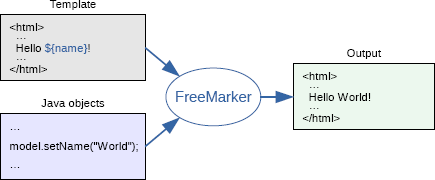
Я также создал класс util / helper (используя jdk 8), который может форматировать строку и заменяет вхождения переменных.
Для этого я использовал метод Matchers "appendReplacement", который выполняет все подстановки и циклы только над затронутыми частями строки формата.
Вспомогательный класс В настоящее время не очень хорошо документирован javadoc. Я изменю это в будущем ;) В любом случае я прокомментировал самые важные строки (я надеяться.)
    public class FormatHelper {

    //Prefix and suffix for the enclosing variable name in the format string.
    //Replace the default values with any you need.
    public static final String DEFAULT_PREFIX = "${";
    public static final String DEFAULT_SUFFIX = "}";

    //Define dynamic function what happens if a key is not found.
    //Replace the defualt exception with any "unchecked" exception type you need or any other behavior.
    public static final BiFunction<String, String, String> DEFAULT_NO_KEY_FUNCTION =
            (fullMatch, variableName) -> {
                throw new RuntimeException(String.format("Key: %s for variable %s not found.",
                                                         variableName,
                                                         fullMatch));
            };
    private final Pattern variablePattern;
    private final Map<String, String> values;
    private final BiFunction<String, String, String> noKeyFunction;
    private final String prefix;
    private final String suffix;

    public FormatHelper(Map<String, String> values) {
        this(DEFAULT_NO_KEY_FUNCTION, values);
    }

    public FormatHelper(
            BiFunction<String, String, String> noKeyFunction, Map<String, String> values) {
        this(DEFAULT_PREFIX, DEFAULT_SUFFIX, noKeyFunction, values);
    }

    public FormatHelper(String prefix, String suffix, Map<String, String> values) {
        this(prefix, suffix, DEFAULT_NO_KEY_FUNCTION, values);
    }

    public FormatHelper(
            String prefix,
            String suffix,
            BiFunction<String, String, String> noKeyFunction,
            Map<String, String> values) {
        this.prefix = prefix;
        this.suffix = suffix;
        this.values = values;
        this.noKeyFunction = noKeyFunction;

        //Create the Pattern and quote the prefix and suffix so that the regex don't interpret special chars.
        //The variable name is a "\w+" in an extra capture group.
        variablePattern = Pattern.compile(Pattern.quote(prefix) + "(\w+)" + Pattern.quote(suffix));
    }

    public static String format(CharSequence format, Map<String, String> values) {
        return new FormatHelper(values).format(format);
    }

    public static String format(
            CharSequence format,
            BiFunction<String, String, String> noKeyFunction,
            Map<String, String> values) {
        return new FormatHelper(noKeyFunction, values).format(format);
    }

    public static String format(
            String prefix, String suffix, CharSequence format, Map<String, String> values) {
        return new FormatHelper(prefix, suffix, values).format(format);
    }

    public static String format(
            String prefix,
            String suffix,
            BiFunction<String, String, String> noKeyFunction,
            CharSequence format,
            Map<String, String> values) {
        return new FormatHelper(prefix, suffix, noKeyFunction, values).format(format);
    }

    public String format(CharSequence format) {

        //Create matcher based on the init pattern for variable names.
        Matcher matcher = variablePattern.matcher(format);

        //This buffer will hold all parts of the formatted finished string.
        StringBuffer formatBuffer = new StringBuffer();

        //loop while the matcher finds another variable (prefix -> name <- suffix) match
        while (matcher.find()) {

            //The root capture group with the full match e.g ${variableName}
            String fullMatch = matcher.group();

            //The capture group for the variable name resulting from "(\w+)" e.g. variableName
            String variableName = matcher.group(1);

            //Get the value in our Map so the Key is the used variable name in our "format" string. The associated value will replace the variable.
            //If key is missing (absent) call the noKeyFunction with parameters "fullMatch" and "variableName" else return the value.
            String value = values.computeIfAbsent(variableName, key -> noKeyFunction.apply(fullMatch, key));

            //Escape the Map value because the "appendReplacement" method interprets the $ and \ as special chars.
            String escapedValue = Matcher.quoteReplacement(value);

            //The "appendReplacement" method replaces the current "full" match (e.g. ${variableName}) with the value from the "values" Map.
            //The replaced part of the "format" string is appended to the StringBuffer "formatBuffer".
            matcher.appendReplacement(formatBuffer, escapedValue);
        }

        //The "appendTail" method appends the last part of the "format" String which has no regex match.
        //That means if e.g. our "format" string has no matches the whole untouched "format" string is appended to the StringBuffer "formatBuffer".
        //Further more the method return the buffer.
        return matcher.appendTail(formatBuffer)
                      .toString();
    }

    public String getPrefix() {
        return prefix;
    }

    public String getSuffix() {
        return suffix;
    }

    public Map<String, String> getValues() {
        return values;
    }
}
вы можете создать экземпляр класса для конкретной карты со значениями (или суффикс префикс или noKeyFunction) как:
    Map<String, String> values = new HashMap<>();
    values.put("firstName", "Peter");
    values.put("lastName", "Parker");


    FormatHelper formatHelper = new FormatHelper(values);
    formatHelper.format("${firstName} ${lastName} is Spiderman!");
    // Result: "Peter Parker is Spiderman!"
    // Next format:
    formatHelper.format("Does ${firstName} ${lastName} works as photographer?");
    //Result: "Does Peter Parker works as photographer?"
Кроме того, вы можете определить, что произойдет, если ключ в карте значений отсутствует (работает в обоих направлениях, например, неправильное имя переменной в строке формата или отсутствующий ключ в карте). Поведение по умолчанию-это выброшенное непроверенное исключение (непроверенное, потому что я использую функция jdk8 по умолчанию, которая не может обрабатывать проверенные исключения) как:
    Map<String, String> map = new HashMap<>();
    map.put("firstName", "Peter");
    map.put("lastName", "Parker");


    FormatHelper formatHelper = new FormatHelper(map);
    formatHelper.format("${missingName} ${lastName} is Spiderman!");
    //Result: RuntimeException: Key: missingName for variable ${missingName} not found.
Вы можете определить пользовательское поведение в конструкторе вызов:
Map<String, String> values = new HashMap<>();
values.put("firstName", "Peter");
values.put("lastName", "Parker");


FormatHelper formatHelper = new FormatHelper(fullMatch, variableName) -> variableName.equals("missingName") ? "John": "SOMETHING_WRONG", values);
formatHelper.format("${missingName} ${lastName} is Spiderman!");
// Result: "John Parker is Spiderman!"
или делегировать его обратно к поведению ключа по умолчанию нет:
...
    FormatHelper formatHelper = new FormatHelper((fullMatch, variableName) ->   variableName.equals("missingName") ? "John" :
            FormatHelper.DEFAULT_NO_KEY_FUNCTION.apply(fullMatch,
                                                       variableName), map);
...
Для лучшей обработки существуют также статические представления методов, такие как:
Map<String, String> values = new HashMap<>();
values.put("firstName", "Peter");
values.put("lastName", "Parker");

FormatHelper.format("${firstName} ${lastName} is Spiderman!", map);
// Result: "Peter Parker is Spiderman!"
Comments